Introduction
Records Management & Retention Tools are specialised systems designed to systematically create, store, classify, retain, and dispose of records in line with legal, regulatory, and business requirements. These tools go far beyond simple document storage. They define how long information should be kept, who can access it, when it must be archived, and when it should be defensibly destroyed.
In today’s digital-first world, organisations generate massive volumes of structured and unstructured data—contracts, HR files, emails, financial records, medical data, and more. Without proper records management, businesses face regulatory penalties, legal risks, data breaches, operational inefficiencies, and rising storage costs.
Real-world use cases include:
- Regulatory compliance (GDPR, HIPAA, SOX, ISO, public records laws)
- Legal hold and eDiscovery readiness
- Automated retention and defensible deletion
- Audit trails and governance
- Long-term digital preservation
What to look for when choosing a Records Management & Retention Tool:
- Flexible retention schedules and policies
- Automated classification and lifecycle management
- Strong security and compliance controls
- Auditability and legal defensibility
- Integration with ECM, DMS, email, and business systems
- Scalability and long-term reliability
Best for:
Compliance officers, legal teams, IT leaders, records managers, government agencies, healthcare organisations, financial institutions, and enterprises with strict regulatory obligations.
Not ideal for:
Individuals or small teams with minimal compliance needs, short-term projects, or organisations that only require basic file storage without formal retention or governance policies.
Top 10 Records Management & Retention Tools
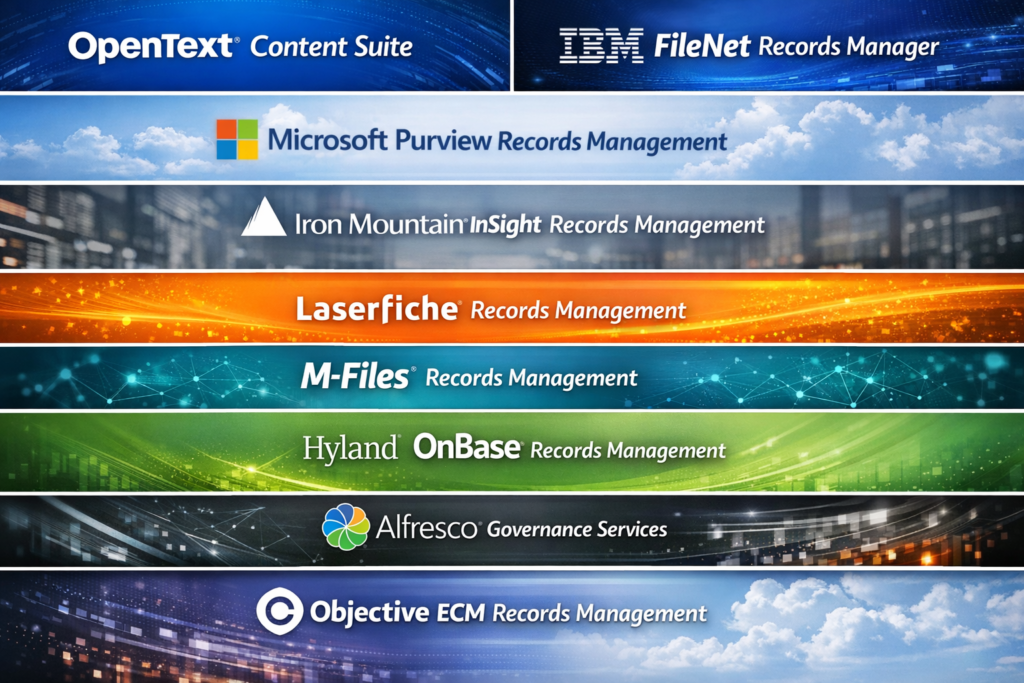
1 — OpenText Content Suite
Short description:
An enterprise-grade information governance platform designed for large organisations managing complex compliance, legal, and regulatory requirements.
Key features:
- Advanced records lifecycle management
- Automated retention and disposition
- Legal holds and eDiscovery readiness
- Enterprise-wide classification and metadata
- Strong audit trails and reporting
- Deep integration with ECM and business systems
Pros:
- Extremely robust and legally defensible
- Trusted by regulated enterprises worldwide
- Scales to millions of records
Cons:
- High implementation complexity
- Premium pricing
Security & compliance:
SSO, encryption, audit logs, GDPR, HIPAA, ISO, SOC 2 (varies by deployment)
Support & community:
Enterprise-level support, extensive documentation, and professional services available
2 — IBM FileNet Records Manager
Short description:
A powerful records governance solution designed for organisations with high compliance, automation, and scalability requirements.
Key features:
- Policy-based retention and disposition
- Automated classification
- Legal hold management
- Integration with the IBM ECM ecosystem
- Audit-ready reporting
- Workflow automation
Pros:
- Excellent governance depth
- Strong automation capabilities
- Proven reliability at scale
Cons:
- Requires skilled administration
- Less intuitive for non-technical users
Security & compliance:
Encryption, SSO, audit trails, GDPR, ISO, industry-specific compliance
Support & community:
Enterprise support, detailed documentation, professional consulting
3 — Microsoft Purview Records Management
Short description:
A cloud-native records management solution integrated into Microsoft 365 for organisations already using Microsoft ecosystems.
Key features:
- Retention labels and policies
- Automated disposition reviews
- Event-based retention
- eDiscovery integration
- Data classification and sensitivity labels
- Native Microsoft 365 integration
Pros:
- Seamless for Microsoft users
- Strong automation and AI classification
- No separate infrastructure needed
Cons:
- Limited outside the Microsoft ecosystem
- Advanced features require premium licenses
Security & compliance:
Encryption, SSO, GDPR, ISO, SOC 2, Microsoft compliance framework
Support & community:
Extensive documentation, global user community, enterprise support
4 — Iron Mountain InSight
Short description:
A modern digital records management platform backed by Iron Mountain’s expertise in physical and digital information governance.
Key features:
- Hybrid physical and digital records management
- Retention scheduling and defensible destruction
- Metadata-driven classification
- Compliance dashboards
- Secure long-term preservation
Pros:
- Strong governance heritage
- Excellent for hybrid records
- Trusted compliance reputation
Cons:
- UI can feel conservative
- Customisation may require support
Security & compliance:
Encryption, audit logs, GDPR, ISO, industry-specific standards
Support & community:
Professional onboarding, managed services, enterprise support
5 — Laserfiche Records Management
Short description:
A flexible records management solution suitable for mid-market and public sector organisations.
Key features:
- Automated retention schedules
- Metadata-based classification
- Legal holds and audits
- Workflow automation
- Policy enforcement
- Records dashboards
Pros:
- User-friendly interface
- Strong automation without heavy coding
- Good balance of power and usability
Cons:
- Less suited for ultra-large enterprises
- Advanced customisation requires expertise
Security & compliance:
Encryption, audit logs, GDPR, ISO, public-sector compliance
Support & community:
Strong documentation, active user community, certified partners
6 — M-Files Records Management
Short description:
A metadata-driven records management approach that emphasises automation and intelligent classification.
Key features:
- Metadata-based records control
- Automated retention rules
- Version control and audit trails
- AI-assisted classification
- Workflow-driven governance
Pros:
- Intuitive and modern UX
- Reduces manual filing
- Flexible deployment options
Cons:
- Learning curve around metadata concepts
- Some compliance features vary by edition
Security & compliance:
Encryption, SSO, GDPR, ISO, audit logging
Support & community:
Good documentation, partner ecosystem, enterprise support
7 — Hyland OnBase
Short description:
A comprehensive content and records management platform widely used in healthcare, finance, and government sectors.
Key features:
- Centralised records governance
- Retention and disposition automation
- Compliance reporting
- Integrated case management
- Secure access controls
Pros:
- Strong vertical-specific solutions
- Reliable and scalable
- Proven compliance track record
Cons:
- Implementation can be lengthy
- UI feels dated to some users
Security & compliance:
HIPAA, GDPR, ISO, audit logs, encryption
Support & community:
Enterprise support, training programs, and user conferences
8 — Alfresco Governance Services
Short description:
An open-architecture governance solution designed for organisations seeking flexibility and open standards.
Key features:
- Policy-based retention
- Records declaration and classification
- Legal holds
- Open APIs
- Cloud and on-prem options
Pros:
- Open and extensible
- Developer-friendly
- Cost-effective compared to legacy platforms
Cons:
- Requires technical expertise
- UI is less polished than premium tools
Security & compliance:
Encryption, audit trails, GDPR, ISO (deployment-dependent)
Support & community:
Open-source community, enterprise support available
9 — Objective ECM (Records Management)
Short description:
A records-centric ECM platform designed primarily for the public sector and regulated industries.
Key features:
- Compliance-focused records lifecycle
- Automated retention
- Policy enforcement
- Strong auditability
- Secure collaboration
Pros:
- Excellent for government compliance
- Strong governance model
- Clear records-first design
Cons:
- Less flexible for commercial use
- Smaller ecosystem
Security & compliance:
Encryption, audit logs, public-sector compliance standards
Support & community:
Vendor-led support, sector-specific expertise
10 — DocuWare Records Management
Short description:
A cloud-first document and records management solution aimed at SMBs and mid-market organisations.
Key features:
- Automated retention rules
- Secure cloud storage
- Workflow-based governance
- Audit trails
- Simple policy configuration
Pros:
- Easy to deploy
- Lower total cost of ownership
- Clean, modern interface
Cons:
- Limited advanced legal features
- Less suited for very large enterprises
Security & compliance:
Encryption, GDPR, audit logs, ISO-aligned controls
Support & community:
Good onboarding, responsive support, growing user base
Comparison Table
| Tool Name | Best For | Platform(s) Supported | Standout Feature | Rating |
|---|---|---|---|---|
| OpenText Content Suite | Large enterprises | Cloud / On-prem | Enterprise-grade governance | N/A |
| IBM FileNet | Regulated industries | Cloud / On-prem | Automation depth | N/A |
| Microsoft Purview | Microsoft users | Cloud | Native M365 integration | N/A |
| Iron Mountain InSight | Hybrid records | Cloud | Physical + digital governance | N/A |
| Laserfiche | Mid-market & public sector | Cloud / On-prem | Workflow simplicity | N/A |
| M-Files | Knowledge-driven orgs | Cloud / Hybrid | Metadata-first design | N/A |
| Hyland OnBase | Healthcare & finance | Cloud / On-prem | Vertical compliance | N/A |
| Alfresco Governance | Open-source adopters | Cloud / On-prem | Open APIs | N/A |
| Objective ECM | Government agencies | Cloud / On-prem | Records-first model | N/A |
| DocuWare | SMBs | Cloud | Fast deployment | N/A |
Evaluation & Scoring of Records Management & Retention Tools
| Tool | Core Features (25%) | Ease of Use (15%) | Integrations (15%) | Security (10%) | Performance (10%) | Support (10%) | Price/Value (15%) | Total |
|---|---|---|---|---|---|---|---|---|
| OpenText | 24 | 10 | 14 | 10 | 9 | 9 | 8 | 84 |
| Microsoft Purview | 22 | 14 | 15 | 10 | 9 | 9 | 10 | 89 |
| Laserfiche | 21 | 14 | 12 | 9 | 8 | 8 | 12 | 84 |
| M-Files | 21 | 13 | 12 | 9 | 8 | 8 | 11 | 82 |
| DocuWare | 18 | 15 | 11 | 8 | 8 | 8 | 14 | 82 |
Which Records Management & Retention Tool Is Right for You?
- Solo users / small teams: Lightweight cloud tools with basic retention
- SMBs: DocuWare or M-Files for affordability and usability
- Mid-market: Laserfiche or Alfresco for flexibility
- Enterprise: OpenText, IBM FileNet, or Microsoft Purview
Budget-conscious: Cloud-native tools with bundled compliance
Premium solutions: Deep governance, legal defensibility, scalability
Ease of use vs depth: Metadata-driven vs policy-heavy platforms
Integrations: Consider email, ERP, ECM, and legal systems
Security & compliance: Match tool certifications to regulatory exposure
Frequently Asked Questions (FAQs)
- What is records retention?
It defines how long records must be kept before lawful disposal. - Are records management and document management the same?
No. Records management focuses on compliance and lifecycle, not just storage. - Do small businesses need records retention tools?
Only if they face regulatory or legal obligations. - What is defensible deletion?
Legally compliant destruction backed by audit trails. - Can these tools manage emails?
Yes, many integrate with email platforms. - Is cloud records management compliant?
Yes, if certifications and controls are met. - How long does implementation take?
From days (SMB) to months (enterprise). - Are AI features important?
They help automate classification at scale. - What’s the biggest mistake buyers make?
Underestimating compliance complexity. - Can tools adapt to changing laws?
Yes, with configurable retention policies.
Conclusion
Records Management & Retention Tools are critical compliance and governance systems, not optional add-ons. The right solution protects organisations from legal risk, reduces operational chaos, and ensures trustworthy information management.
There is no universal “best” tool. Enterprises prioritise defensibility and scale, while SMBs value simplicity and cost. The best choice depends on regulatory exposure, data volume, integrations, and long-term governance strategy. Choose with clarity, not just features.