Introduction
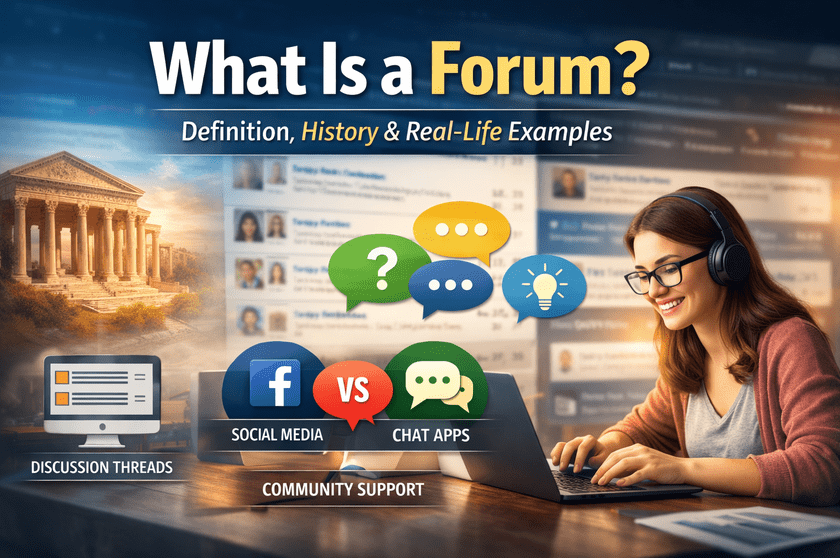
In today’s digital world, people interact online in many ways—through social media, chat apps, and discussion platforms. One of the oldest and most structured ways to communicate online is through a forum.
Forums are not about quick messages or short reactions. They are designed for meaningful discussions, long-term knowledge sharing, and community building. This article explains what a forum is, its definition, history, how it compares with social media and chat apps, and real-life use cases where forums are still extremely valuable.
What Is a Forum?
A forum is an online discussion platform where users can create topics (called threads), post messages, and reply to other users in an organized, topic-based structure.
Unlike chat apps or social media feeds, forum discussions are:
- Structured
- Searchable
- Archived for long-term use
Forums are commonly used for support, education, professional discussions, and niche communities.
Definition of a Forum
A forum is a web-based platform that allows users to hold structured discussions by posting messages and replies under specific topics or categories.
Key characteristics of a forum:
- Discussions are organized into categories and threads
- Messages remain available for future users
- Users interact asynchronously (not real-time)
- Moderation ensures quality and order
History of Forums
Early Days (1980s–1990s)
The concept of forums began with Bulletin Board Systems (BBS), where users connected via dial-up internet to post messages and read discussions.
Internet Era (1990s–2000s)
With the growth of the web:
- Usenet groups became popular
- Web-based forums emerged
- Platforms like phpBB and vBulletin gained popularity
Modern Forums (2010–Present)
Even after the rise of social media:
- Forums evolved with better UI, moderation, and SEO
- Q&A-style forums and community forums grew
- Forums remain essential for technical and professional knowledge
Despite new platforms, forums continue to exist because no other system organizes long discussions as efficiently.
Forum vs Social Media vs Chat Apps
| Aspect | Forum | Social Media | Chat Apps |
|---|---|---|---|
| Communication Type | Topic-based discussion | Feed-based updates | Real-time messages |
| Content Structure | Highly organized | Mixed and unstructured | Linear conversations |
| Searchability | Very high | Medium | Low |
| Content Lifespan | Long-term | Short-lived | Temporary |
| Best For | Knowledge sharing | Engagement & promotion | Instant communication |
Forum vs Social Media
Social media platforms like Facebook or Instagram are designed for:
- Quick updates
- Likes and reactions
- Viral content
Forums focus on:
- Detailed discussions
- Problem-solving
- Long-term reference
Forum vs Chat Apps
Chat apps like WhatsApp or Telegram are great for:
- Instant communication
- Small group conversations
Forums are better when:
- Discussions need structure
- Answers must be found later
- Many people participate over time
Real-Life Use Cases of Forums
1. Technical Support Forums
When users face software or technical issues, forums provide step-by-step solutions that remain available for years.
Real-life example:
A developer searches an error message on Google and finds a forum thread where someone already explained the solution in detail.
2. Medical & Health Discussion Forums
Patients and caregivers use forums to:
- Share experiences
- Discuss treatments
- Learn from others with similar conditions
These discussions are often more detailed than social media posts.
3. Educational & Learning Forums
Students use forums to:
- Ask academic questions
- Discuss concepts
- Share study resources
Unlike chat apps, forum answers remain useful for future learners.
4. Product & Customer Support Communities
Many companies maintain forums where users:
- Ask product-related questions
- Suggest features
- Report issues
This reduces customer support load and builds trust.
5. Hobby & Interest Communities
Forums exist for:
- Travel
- Photography
- Automobiles
- Gaming
- Fitness
People prefer forums because conversations stay focused and organized.
6. Professional & Industry Forums
Professionals use forums to:
- Share industry knowledge
- Discuss best practices
- Solve real-world problems
These discussions often carry more depth than social media comments.
Why Forums Still Matter Today
Even with modern platforms, forums remain relevant because:
- Knowledge is preserved
- Discussions are structured
- Answers are easy to find
- Communities grow organically
Forums are not about speed, they are about value and clarity.
Conclusion
A forum is one of the most powerful tools for online discussion and knowledge sharing. From its early history to modern-day applications, forums continue to serve a purpose that social media and chat apps cannot fully replace.
If you want organized discussions, long-term answers, and meaningful community interaction, forums are still the best solution.