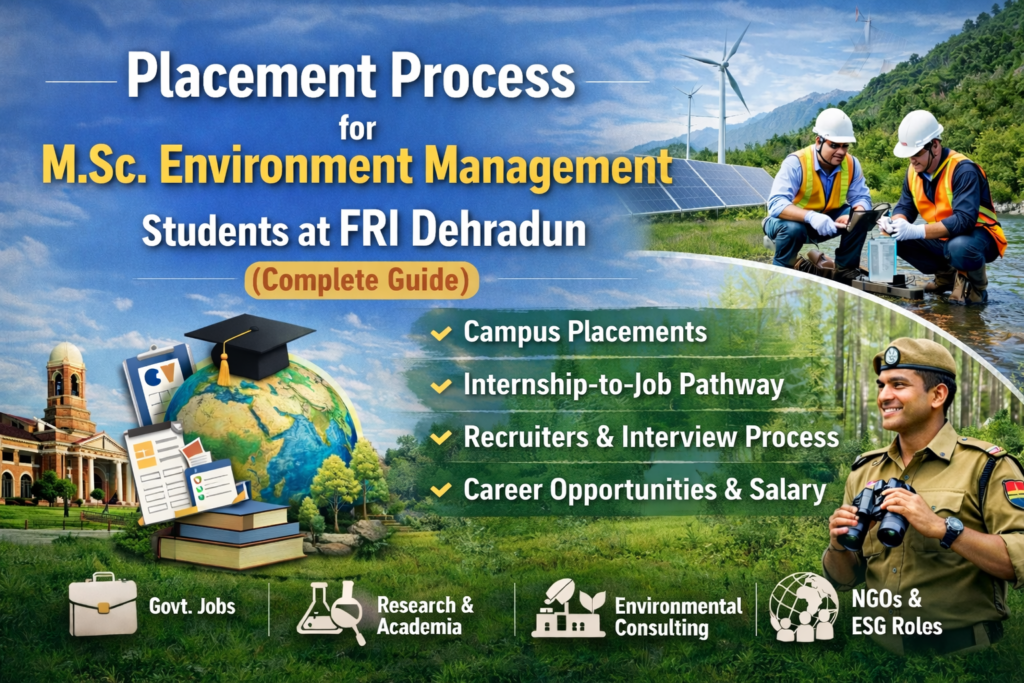
A Complete Step-by-Step Guide
Introduction
The M.Sc. Environment Management program at the Forest Research Institute (FRI), Dehradun is one of the most respected postgraduate environmental courses in India. While many students are aware of the academic and research strength of FRI, there is often confusion about the placement process, how it works, and what students should realistically expect.
This blog provides a detailed explanation of the placement process for M.Sc. Environment Management students at FRI Dehradun, including preparation stages, recruiter engagement, selection procedure, and practical career pathways.
Overview of Placements at FRI Dehradun
Placements at FRI are academically driven and skill-oriented, not mass-recruitment based. The institute focuses on:
- Environmental consulting roles
- Research and project-based positions
- Sustainability and ESG roles
- NGO and government-linked opportunities
Many students also opt for higher studies, PhD, NET preparation, or competitive exams, which influences the overall placement percentage.
Role of the Placement Cell
FRI has a dedicated Placement Cell / Placement Coordinator that acts as a bridge between students and recruiting organizations.
Responsibilities of the Placement Cell:
- Collecting student profiles and CVs
- Coordinating with recruiters, NGOs, consultancies, and research bodies
- Organizing campus interviews and recruitment drives
- Sharing off-campus job and internship opportunities
- Guiding students on placement rules and timelines
Students must register officially with the placement cell to participate in campus placements.
Step-by-Step Placement Process
Step 1: Student Registration & Profile Submission
At the beginning of the placement season (usually in the final year):
- Students submit their resume, academic details, skills, and internship experience
- A standardized CV format may be suggested by the placement cell
- Students indicate interest areas such as:
- Environmental consultancy
- Research & academia
- NGOs & development sector
- Sustainability & ESG roles
Early registration improves visibility among recruiters.
Step 2: Pre-Placement Preparation
Before companies start visiting, students are encouraged to prepare through:
Academic & Technical Preparation
- Strong understanding of:
- Environmental Impact Assessment (EIA)
- Environmental laws & policies
- Climate change and sustainability
- Waste management, water, air pollution
- Project work and dissertation play a critical role here
Skill Development
- GIS and Remote Sensing
- Environmental auditing & monitoring
- Data analysis and report writing
- ESG frameworks (GRI, SDGs, carbon accounting)
Soft Skills
- Communication skills
- Interview etiquette
- Presentation skills
- Group discussion techniques
Step 3: Recruiter Outreach & Job Announcements
Recruiters associated with FRI typically include:
- Environmental consulting firms
- Research institutes and think tanks
- NGOs and international organizations
- Sustainability and ESG consulting firms
- CSR divisions of corporates
Opportunities are shared via:
- Placement notices
- Email communication
- Placement cell announcements
- Alumni references
Recruitment can be on-campus, hybrid, or off-campus, depending on the organization.
Step 4: Resume Shortlisting
Recruiters shortlist candidates based on:
- Academic performance
- Relevant internships
- Dissertation topic and fieldwork
- Technical skills (EIA, GIS, data analysis)
- Communication ability
Students with hands-on project and internship experience have a clear advantage at this stage.
Step 5: Interview & Selection Rounds
Shortlisted candidates usually go through:
Technical Interview
- Questions on environmental concepts
- Case studies related to EIA, sustainability, or pollution control
- Discussion of dissertation or internship work
HR / Personal Interview
- Career goals
- Interest in the environmental sector
- Willingness for fieldwork or project-based roles
- Understanding of organizational objectives
Some recruiters may also conduct:
- Written tests
- Case study presentations
- Online interviews
Step 6: Final Selection & Offer Letter
After successful interviews:
- Selected students receive offer letters
- The placement cell verifies offer details
- Students decide to accept or decline the offer
Salary packages vary depending on role, organization, and student skillset.
Internship-to-Placement Pathway (Very Common at FRI)
At FRI, internships often convert into full-time roles, especially in:
- Environmental consulting firms
- NGOs and development organizations
- Research projects funded by government agencies
Students who perform well during internships gain:
- Practical experience
- Strong recommendations
- Direct absorption into the organization
This is one of the most reliable placement routes for Environment Management students.
Placement Statistics (General Trend)
- Placement percentage: ~60–65%
- Average package: ₹4–5.5 LPA
- Higher packages: Up to ₹8–9.5 LPA (skill- and role-dependent)
- Many students opt for:
- PhD and research
- Government exam preparation
- International fellowships
Key Factors That Improve Placement Chances
✔ Relevant internships and field projects
✔ Strong dissertation aligned with industry needs
✔ Technical skills (GIS, EIA, ESG tools)
✔ Good communication and presentation skills
✔ Active networking with alumni and faculty
✔ Willingness to start with project-based or field roles